
[October 2026] Explore the Solar System! Activities & Resources for Kids Ages 8–11
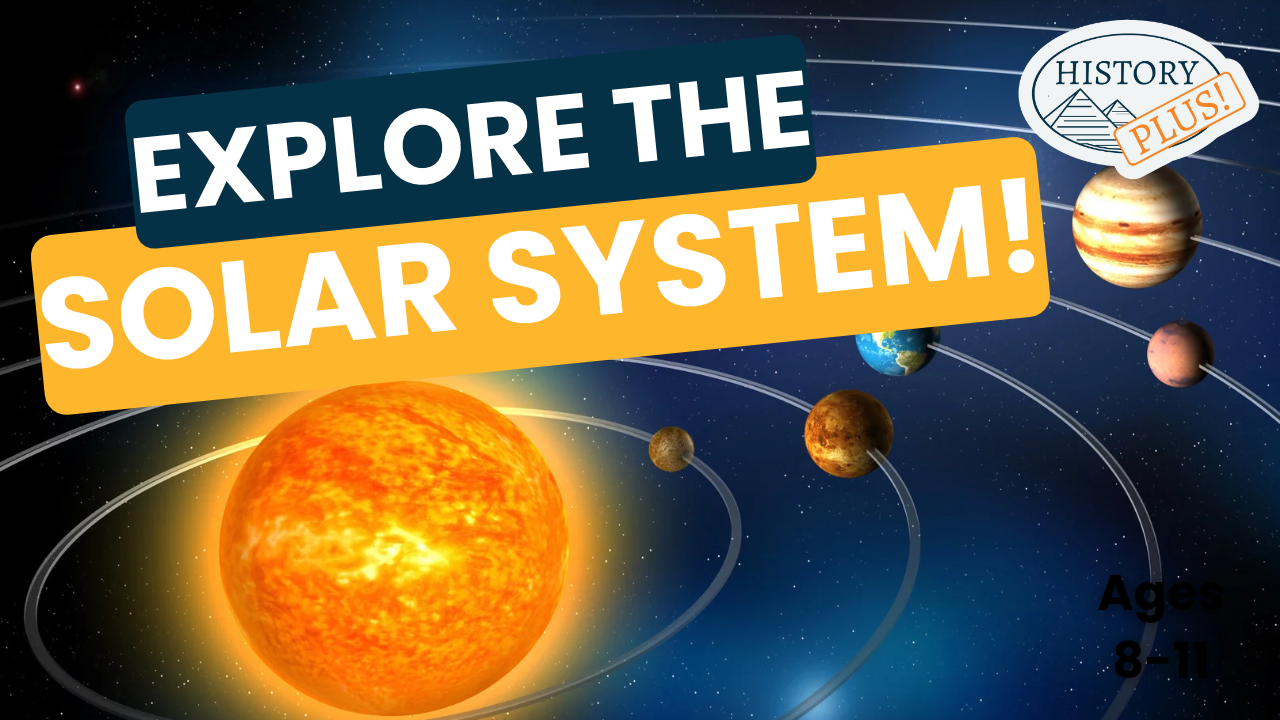
Explore the Solar System! – Activities for Kids Ages 8–11
Our solar system is an enormous neighbourhood filled with planets, moons, asteroids, comets, and one very important star—the Sun.
Some planets are rocky worlds with mountains and volcanoes. Others are enormous balls of gas surrounded by rings and dozens of moons. Temperatures range from incredibly hot to unbelievably cold, and distances become so enormous that kilometres and miles quickly become difficult to imagine.
This month, we’re exploring the Solar System! Here are a few hands-on ways to continue the adventure at home.
1. Make a Scale Solar System
Pictures make the planets look like they’re sitting close together, but the solar system is mostly empty space. A scale model is one of the best ways to see just how enormous those distances really are.
For this model, imagine that the distance from the Sun to Earth is 1 m (3.3 ft.). (one Astronomical Unit)
Starting with the Sun, place Mercury 39 cm (15 in.) away, Venus 72 cm (28 in.) away, and Earth at 1 m (3.3 ft.). Mars belongs at 1.52 m (5 ft.), but then the distances really start to grow. Jupiter is 5.2 m (17 ft.) from your Sun, Saturn is 9.5 m (31 ft.), Uranus is 19.2 m (63 ft.), and Neptune is a whopping 30.1 m (99 ft.) away.
You’ll need about 30 m (100 ft.) of space to build the entire model. A sidewalk, park, school field, or long driveway works well. Use labelled cards, rocks, balls, or other small objects to mark each planet.
If you don’t have that much space, make a smaller version. If Earth is only 10 cm (4 in.) from the Sun, Neptune will be about 3 m (10 ft.) away. Or go bigger! If Earth is 5 m (16.4 ft.) from the Sun, you’ll have to walk about 150 m (492 ft.) before reaching Neptune.
As you move through your model, notice how quickly the planets spread apart. The four rocky planets are crowded near the Sun, while the outer solar system contains enormous stretches of almost completely empty space.
Challenge: Where would Pluto belong? At the 1-metre scale, its average distance would put it about 39.5 m (130 ft.) from your Sun.
2. Investigate Impact Craters
The Moon, Mercury, Mars, and many other worlds are covered in craters created by impacts.
You can make your own miniature crater field using a container filled with flour. Sprinkle a thin layer of cocoa powder over the top so changes to the surface are easy to see.
Then drop marbles or small balls from different heights. Experiment with the size of the object, the height of the drop, the angle of impact, and the speed of the object.
Measure the diameter of each crater in centimetres and inches. Does doubling the drop height double the size of the crater? Which variable seems to make the biggest difference?
3. How Big Are the Planets?
E
Earth feels enormous when you’re standing on it, but compared with some of our planetary neighbours, it isn’t especially large. Building the planets to scale is a great way to see just how different their sizes really are.
For an easy model, imagine that Earth is a ball 2.5 cm (1 in.) across.
At this scale, Mercury would be about 1 cm (0.4 in.) across, while Venus would be almost the same size as Earth at about 2.4 cm (0.95 in.). Mars would be much smaller at about 1.3 cm (0.5 in.).
Then come the giants.
Jupiter would be about 28 cm (11 in.) across—roughly the size of a large dinner plate. Saturn would measure about 23.5 cm (9.3 in.), while Uranus and Neptune would each be around 10 cm (4 in.) across.
Try finding balls, fruit, modelling clay, or other household objects that roughly match these sizes. You could also cut circles from cardboard or paper and arrange all eight planets side by side.
Once you’ve built them, compare the rocky planets with the four giants. Jupiter is about 11 times wider than Earth, and more than 1,300 Earths could fit inside it by volume.
Challenge: Add the Sun to the same model. If Earth is 2.5 cm (1 in.) across, your Sun would need to be about 2.7 m (9 ft.) across!
Keep Exploring
The eight planets are only the beginning of our solar system. Beyond them are dwarf planets, asteroids, comets, icy worlds, and thousands of smaller objects that scientists are still studying today.
And we’re still discovering new things about our own cosmic neighbourhood.
Hands-On Activities & Experiments
- NASA JPL – Solar System Bead Activity — Create a pocket-sized model showing the enormous distances between objects in our solar system. https://www.jpl.nasa.gov/edu/resources/lesson-plan/solar-system-bead-activity/
- NASA JPL – Modeling the Structure of the Solar System — Build a scale model to investigate the relative distances between the Sun and planets. https://www.jpl.nasa.gov/edu/resources/lesson-plan/modeling-the-structure-of-the-solar-system/
- Exploratorium – Your Weight on Other Worlds — Find out how much you would weigh on different planets and moons and explore how gravity changes from world to world. https://www.exploratorium.edu/explore/solar-system/weight
- National Geographic Kids – Space — Articles, photographs, facts, and videos introducing kids to planets, moons, space exploration, and our universe. https://kids.nationalgeographic.com/space
Websites & Further Exploration
- NASA – Solar System Exploration — NASA’s main hub for exploring the Sun, planets, dwarf planets, moons, asteroids, and comets, with real spacecraft images and current discoveries. https://science.nasa.gov/solar-system/
- NASA Space Place – Solar System — A more kid-friendly NASA resource featuring short articles, activities, crafts, games, and explanations about our solar system. https://spaceplace.nasa.gov/menu/solar-system/
- Britannica Kids – Solar System — A straightforward reference for researching the planets, Sun, moons, asteroids, comets, and other parts of our solar system. https://kids.britannica.com/kids/article/solar-system/
- The Planetary Society – Our Solar System — Explore individual planets and worlds through excellent images and accessible explanations of what scientists have discovered about them. https://www.planetary.org/worlds
Books
- The Mysteries of the Universe — Will Gater — A beautifully illustrated DK book exploring planets, moons, stars, galaxies, and many of the most fascinating objects in space.
Amazon.ca – The Mysteries of the Universe - Professor Astro Cat’s Solar System — Dr. Dominic Walliman & Ben Newman — A colourful tour through the Sun, planets, moons, and other objects in our solar system with plenty of interesting science along the way.
Amazon.ca – Professor Astro Cat's Solar System - National Geographic Kids Ultimate Explorer Field Guide: Night Sky — Howard Schneider — An approachable guide for kids who want to take their exploration outside and begin identifying planets, stars, constellations, and other objects in the night sky.
Amazon.ca – Ultimate Explorer Field Guide: Night Sky - Space Encyclopedia: A Tour of Our Solar System and Beyond — David A. Aguilar — A National Geographic reference filled with illustrations, photographs, maps, and explanations of planets and the wider universe.
Amazon.ca – Space Encyclopedia - Everything Awesome About Space and Other Galactic Facts! — Mike Lowery — A humorous, heavily illustrated introduction to planets, stars, astronauts, spacecraft, and strange facts about space.
Amazon.ca – Everything Awesome About Space - The Usborne Book of Astronomy & Space — Lisa Miles and Alastair Smith — A visual introduction to astronomy covering our solar system, stars, galaxies, telescopes, and space exploration.
Amazon.ca – Usborne Astronomy and Space - A Child’s Introduction to the Night Sky — Michael Driscoll — Combines solar-system science with practical stargazing, helping kids understand what they’re seeing when they look into the night sky.
Amazon.ca – A Child's Introduction to the Night Sky - DK Knowledge Encyclopedia Space! — DK — A highly visual reference packed with diagrams and illustrations explaining planets, moons, spacecraft, stars, galaxies, and the scale of the universe.
Amazon.ca – Knowledge Encyclopedia Space!
Join History Plus and experience history in a whole new way.
History Plus members can join us throughout November as we explore the Solar System, from the Sun and planets to moons, space exploration, and some of the strangest worlds orbiting our star.