
[September 2026] When Science Goes Wrong Ages 12-18
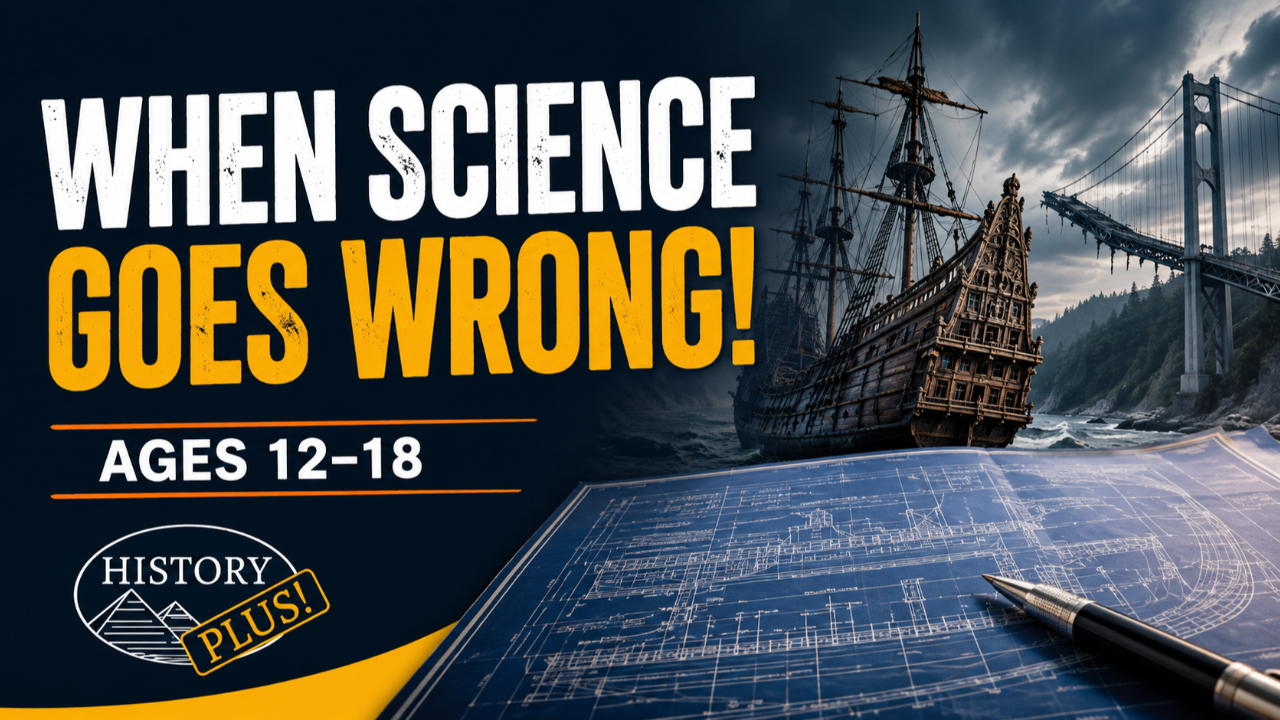
When Science Goes Wrong!
Science Activities & Resources for Ages 12–18
Science has given us electricity, modern transportation, computers, spaceflight, and an ever more detailed understanding of the world around us. Yet none of these achievements shows that science is always correct.
Since the information available to scientists is incomplete, engineers are sometimes forced to make assumptions, medical researchers may fail to notice side effects, measurements may be inaccurate, and equipment may fail. It is useful to study these failures since science is not merely a set of facts; it is a method of testing ideas against evidence and altering those ideas when the evidence no longer supports them.
Some mistakes are relatively harmless. Others have had serious consequences. Here are some really cool cases worth investigating.
The Vasa Disaster
In 1628, Sweden launched one of the most impressive warships in Europe. The Vasa exceeded 60 metres in length and had two enclosed gun decks with numerous heavy cannons. It was also adorned with hundreds of carved sculptures and was intended to showcase the growing military power of King Gustavus Adolphus.
Its first voyage lasted only about 20 minutes. The ship sailed into Stockholm harbour, encountered a gust of wind, leaned heavily to one side and began taking on water through its open gunports. The Vasa sank with the loss of around 30 lives.
The basic problem was stability. A ship’s centre of gravity is affected by how its weight is distributed. Heavy cannon, decks, equipment and other weight high above the waterline can raise the centre of gravity. A vessel with insufficient stability may have difficulty returning upright after it begins to heel.
There were signs that the ship had a problem before it sailed. During a stability test, sailors reportedly ran back and forth across the deck to make the ship roll. The test was stopped after only a few crossings because the ship was rocking so severely. Despite the warning, the Vasa sailed anyway.
The wreck was raised in 1961 and is remarkably well preserved today. It gives historians and engineers an unusual opportunity to examine a seventeenth-century engineering failure almost exactly as it was built.
Test Ship Stability
You can investigate the same basic problem with a small model boat. Make a simple boat from aluminum foil or another waterproof material and float it in a sink or large container.
Add weight near the bottom of the boat and gently tilt it. Observe how easily it returns upright. Now move the same amount of weight higher by stacking it on a block or a platform of aluminum foil. Try again, and keep experimenting with the weight’s location rather than simply adding more.
Make sure you take notes! Write down:
- where the weight was placed
- how far the boat could tilt
- whether it returned upright
- when water began entering the boat
You can also experiment with hull width. How does a narrow hull behave compared with a wider one?
The goal isn’t necessarily to build the boat that carries the most weight. You’re investigating how the distribution of weight changes stability.
Thalidomide and the Importance of Drug Testing
During the late 1950s, thalidomide was sold in numerous countries as a sedative and was also used by pregnant women for nausea. It was considered remarkably safe.
By 1961, physicians were reporting an unusual increase in severe birth defects. Researchers eventually connected these cases to thalidomide taken during pregnancy. More than 10,000 pregnancies worldwide are estimated to have been affected.
The drug never received general approval in the United States. Canadian-born physician and pharmacologist Frances Oldham Kelsey had just joined the U.S. Food and Drug Administration when she was given the task of reviewing the application. Since she was not satisfied with the evidence offered in support of the drug’s safety, she repeatedly asked for more information before agreeing to approve it.
Because of her caution, thalidomide was not widely marketed in the United States, even though some Americans did receive it while it remained an investigational drug. The tragedy also led to major changes in the way new medicines were tested and regulated.
Thalidomide raises an important question about scientific evidence: How much evidence is enough?
Waiting for absolute certainty can prevent useful medicines and technologies from reaching people who need them. Moving too quickly can expose people to risks that haven’t been properly understood. That problem remains a focus of medical research today.
Challenger and the Problem of Risk
On January 28, 1986, the Space Shuttle Challenger broke apart shortly after launch, killing all seven crew members. The immediate physical cause involved seals called O-rings in one of the shuttle’s solid rocket boosters. The unusually cold temperatures on the morning of the launch affected their ability to seal properly.
Yet merely understanding the component that failed is only one aspect of understanding the disaster. Engineers had previously raised concerns regarding the behaviour of the O-rings, and the investigation examined both the hardware and the decision-making process that led to the launch going ahead.
Engineers rarely get to say that a machine has absolutely no chance of failing. Instead, they evaluate risk. How likely is a failure? How serious would the consequences be? How reliable is the available evidence? At what point does uncertainty become a reason to stop?
These are not entirely mathematical questions, since they also require human judgement.
Build a Risk Matrix
Choose five everyday activities. For example:
- Riding a bicycle
- Crossing a busy road
- Flying in an airplane
- Using a ladder
- Swimming in a lake
Give each activity two scores from 1–5:
Likelihood: How likely is something to go wrong?
Severity: How serious could the consequences be?
Multiply the two numbers to create a simple risk score, then look at your results critically. Does the highest number necessarily represent the most dangerous activity? What information are you missing? Would wearing a helmet change the likelihood of a bicycle accident, the severity of an injury, or both?
This is a simplified version of something engineers and safety professionals do regularly: identify hazards, estimate risks and find ways to reduce them.
The Replication Problem
Not every scientific failure involves an explosion, a sinking ship or a failed spacecraft. Sometimes an experiment simply can’t be repeated.
Replication is an important part of science. If a researcher discovers an interesting effect, other scientists should ideally be able to perform the same experiment and obtain similar results. That doesn’t always happen. Researchers in several scientific fields have found that some published results become much weaker or disappear entirely when experiments are repeated.
There are many possible reasons. A study might have used too few participants. Researchers might have made a statistical error. An apparently important result could occur simply by chance. The original experiment may have depended on conditions that weren’t properly recorded.
There is also the problem of publication bias. Suppose ten scientists test whether listening to classical music improves memory. Nine find no meaningful effect, while one finds a large improvement. Which result sounds more interesting?
If only the surprising positive result gets published, someone reading the scientific literature could get a badly distorted picture of the evidence.
Try a Replication Study
Choose a simple claim you can test repeatedly. For example:
Does background music affect how quickly someone completes a word search?
Run the experiment with several volunteers. Have each person complete one similar puzzle with music and another without it, and record the times. Then swap your results with another student or family and have them repeat your experiment using your written instructions.
Compare the results. Did they get the same outcome? If not, don’t immediately decide that one experiment was wrong. Look for differences in your methods. Perhaps the puzzles weren’t equally difficult. Maybe people were already familiar with one of them. Perhaps the type or volume of music mattered.
Replication can expose variables that weren’t obvious during the original experiment.
SL-1: Designing Systems That Expect Human Error
In January 1961, a small experimental nuclear reactor called SL-1 suffered a catastrophic accident in Idaho. During maintenance, the reactor’s central control rod was manually withdrawn too far. The reactor rapidly increased in power, resulting in a steam explosion and meltdown. All three operators present were killed. The accident subsequently influenced improvements in reactor analysis, materials, control systems and reactor design.
There is a more general engineering lesson to be obtained from this. If pulling one component too far can cause a catastrophic failure, should the entire safety system depend on a person never making that mistake?
Modern engineering often uses the idea of fail-safe design. A good system doesn’t simply tell people not to make mistakes. Where possible, it is designed so that predictable mistakes either cannot happen or don’t produce catastrophic results.
You’ve encountered this idea without noticing it. Microwave ovens stop operating when the door opens. Cars prevent drivers from performing certain actions under unsafe conditions. Elevators use multiple safety systems rather than relying on a single cable.
Find the Fail-Safes
Walk through your house and identify five objects that have a safety feature built into their design. For each one, determine:
- What mistake or failure is the feature intended to prevent?
- Does it prevent the mistake or reduce its consequences?
- Could the safety feature itself fail?
- Is there a second layer of protection?
Then choose an everyday object that you think is poorly designed. Redesign it so that a predictable human mistake is less likely to cause a problem.
More Scientific Failures to Investigate
There are many other cases that can be explored from both the scientific and historical sides.
Mars Climate Orbiter
NASA lost the spacecraft in 1999 after different parts of the project used incompatible units of measurement. Investigate how large engineering projects keep hundreds of people working with consistent measurements and specifications.
Tacoma Narrows Bridge
The bridge collapsed in 1940 after wind caused severe twisting of its deck. Look into aeroelastic flutter and why the usual simplified explanation involving resonance doesn’t tell the entire story.
Fukushima Daiichi
Investigate how the 2011 earthquake and tsunami affected the nuclear power station. Separate the damage caused directly by the earthquake from the problems caused by the tsunami and loss of electrical power.
The Hubble Space Telescope
Hubble’s primary mirror was manufactured with a tiny error in its shape. Research how the error occurred, why testing failed to detect it before launch, and how astronauts corrected the telescope’s vision without replacing the primary mirror.
Chernobyl
Examine the interaction between reactor design, operating procedures and human decisions during the 1986 accident. This is a particularly useful case for seeing why major disasters rarely have only one cause.
The De Havilland Comet
The world’s first commercial jet airliner suffered several catastrophic accidents. Investigators eventually discovered problems involving metal fatigue and repeated cabin pressurization. Research how those investigations influenced later aircraft design.
Conduct a Failure Analysis
Choose one scientific or engineering failure and investigate it in detail. Instead of writing a normal report describing what happened, create a failure analysis. Start with the final failure and work backwards.
The immediate cause
What physically failed?
Contributing factors
What conditions made the failure more likely?
Human decisions
Were warnings ignored, misunderstood or unavailable?
Scientific knowledge
Did people understand the phenomenon involved at the time?
Design problems
Could the system tolerate mistakes or unexpected conditions?
Changes afterward
What was redesigned, regulated or understood differently because of the failure?
You’ll probably discover that assigning one cause is difficult. A bolt can break because it was made incorrectly. It can also break because it was carrying more force than expected, because nobody inspected it, because the design had no backup if it failed, or because an engineer didn’t know that the material became brittle under certain conditions. All of those statements can be true at once.
That’s one of the most useful things we can learn from studying science when it goes wrong.