
[October 2026] Engineering for Teens: Activities, Experiments & Resources
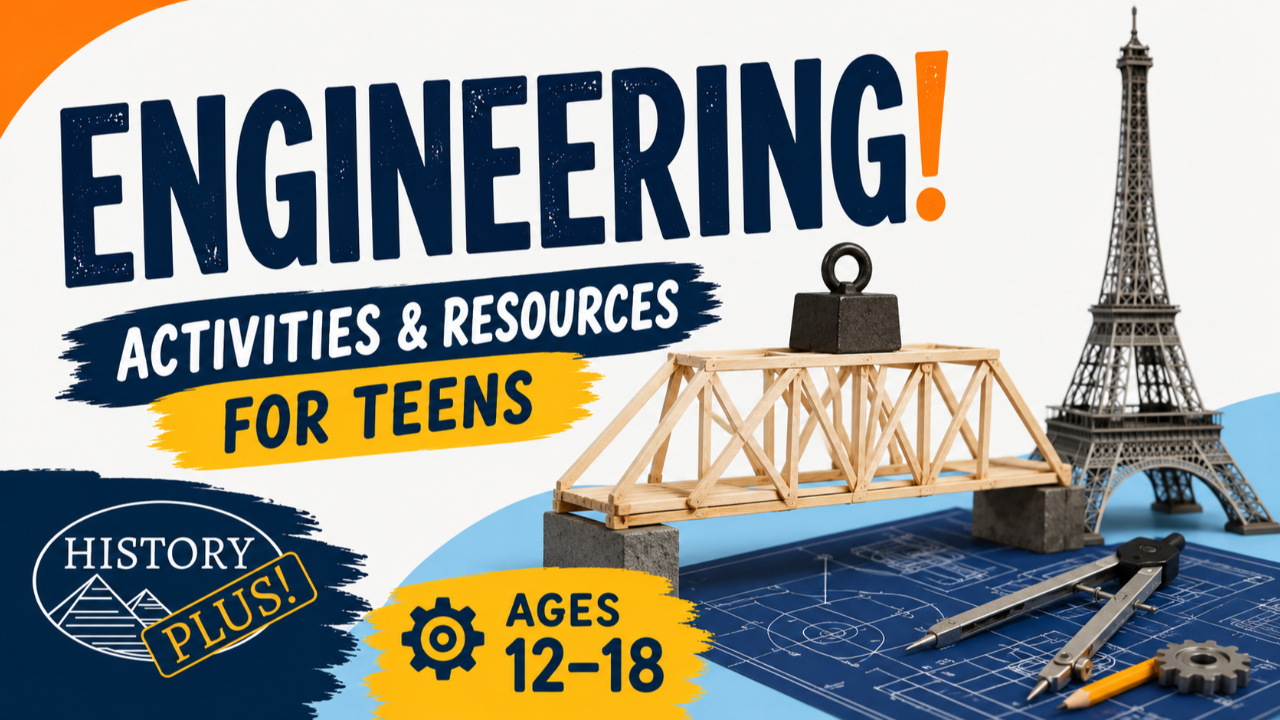
Engineering! – Activities & Resources for Teens Ages 12–18
Engineering is all around us. It shapes the bridges we cross, the buildings we live in, the machines we use, and even the chairs we sit on.
But engineering is about more than building things. Engineers use science, mathematics, creativity, and plenty of trial and error to solve problems. This month, we’re exploring some of the ideas that make engineering possible, from levers and mechanical advantage to tension, compression, and structural design.
Here are a few ways to investigate engineering at home.
1. Build a Bridge
A bridge has to deal with several different forces at once. Two of the most important are tension and compression.
Compression pushes or squeezes material together, while tension pulls it apart. A successful bridge has to distribute these forces without bending, buckling, or breaking.
Try It
Build a bridge spanning at least 30 cm (12 in.) using only:
- Craft sticks
- Paper or cardboard
- String
- Tape or glue
Once it is finished, gradually add weight to the centre.
How much can it hold before failing?
Instead of simply building a stronger second bridge, examine where the first design failed. Was something bending, twisting, pulling apart, or buckling? Use that information to redesign it.
That process—design, test, fail, improve—is an important part of real engineering.
2. Experiment with Levers
Levers allow us to move heavy objects with surprisingly little effort.
Every lever has three important parts:
- Fulcrum: the point around which the lever rotates
- Load: the object being moved
- Effort: the force applied to move it
Changing the position of these three things can dramatically change how much force is required.
Test Mechanical Advantage
Place a ruler or sturdy board over a small block to create a lever.
Put a weight on one end and experiment with moving the fulcrum closer to or farther away from the load.
Measure how much force is needed each time.
Can you determine which arrangement gives you the greatest mechanical advantage?
Then look around your house for real examples of levers. Scissors, wheelbarrows, bottle openers, tweezers, and even your own arms all use the same basic principle in different ways.
3. The Paper Engineering Challenge
Sometimes engineering becomes more interesting when you have very few materials.
Take a single sheet of ordinary paper and see how much weight you can make it support.
You may fold, roll, bend, or cut the paper—but you cannot add another sheet.
Experiment with different shapes.
A flat sheet of paper is weak, but folding that same paper into columns, triangles, tubes, or corrugations can dramatically change its strength.
This illustrates an important engineering principle: the shape of a material can be just as important as the material itself.
Try to improve your design until one sheet of paper can support a stack of books.
5. Reverse Engineer Something
Engineers don’t always begin with a blank page. Sometimes one of the best ways to understand a machine is to figure out how an existing one works.
Choose an old mechanical object that is safe to take apart.
Possible examples include:
- A broken mechanical toy
- An old computer mouse
- A stapler
- A hand-crank pencil sharpener
- A simple clock
- A retractable pen
Photograph each stage as you carefully disassemble it.
Identify the different components and determine what each one does. Look for levers, springs, gears, screws, pivots, and other simple mechanisms.
Then see if you can put everything back together and make it work again.
Think Like an Engineer
Engineering rarely involves finding the perfect solution on the first attempt. Designs are tested, weaknesses are discovered, and improvements are made.
So when one of these challenges doesn’t work, don’t immediately start over.
Look carefully at why it failed.
Hands-On Activities & Experiments
- TeachEngineering – Simple Machines and Mechanical Advantage — Explore levers, pulleys, inclined planes, wheels and axles, and how simple machines make work easier. https://www.teachengineering.org/lessons/cub_simple_lesson01?
- Science Buddies – Paper Roller Coasters — Design a working roller coaster from paper while experimenting with structural design, potential energy, kinetic energy, and motion. https://www.sciencebuddies.org/stem-activities/paper-roller-coaster
- Practical Action – STEM Challenges — Free engineering challenges based around real-world problems, with activities involving structures, materials, design, and technology. https://practicalaction.org/schools/stem-challenges/
Books
- The Way Things Work Now — David Macaulay — A detailed illustrated guide to machines, forces, mechanical systems, and the engineering principles behind everyday technology.
Amazon.ca – The Way Things Work Now - Building Big — David Macaulay — Explores the engineering behind bridges, domes, skyscrapers, dams, and tunnels, with Macaulay’s excellent illustrations helping explain how large structures actually work.
Amazon.ca – Building Big - Structures: Or Why Things Don’t Fall Down — J. E. Gordon — A fascinating and surprisingly readable exploration of tension, compression, materials, structural strength, and why structures sometimes fail. Particularly good for older teens.
Amazon.ca – Structures: Or Why Things Don't Fall Down - The Art of Construction — Mario Salvadori — Uses illustrations and straightforward explanations to show how beams, columns, arches, bridges, skyscrapers, and other structures support enormous loads.
Amazon.ca – The Art of Construction - Engineering: An Illustrated History from Ancient Craft to Modern Technology — Tom Jackson — A visual history of engineering that connects modern technology with centuries of human problem-solving and invention.
Amazon.ca – Engineering by Tom Jackson - The New Science of Strong Materials: Or Why You Don’t Fall Through the Floor — J. E. Gordon — An approachable look at why different materials behave the way they do and how engineers choose materials capable of handling different forces.
Amazon.ca – The New Science of Strong Materials
Want to learn more?
Join History Plus and experience history in a whole new way.
History Plus members can join us throughout October as we explore Engineering, including Gustave Eiffel, fulcrums and levers, tension and compression, structural design, and much more.