
[October 2026] Exploring Deep Space: Spacecraft, Scientists & Activities for Teens Ages 12-18
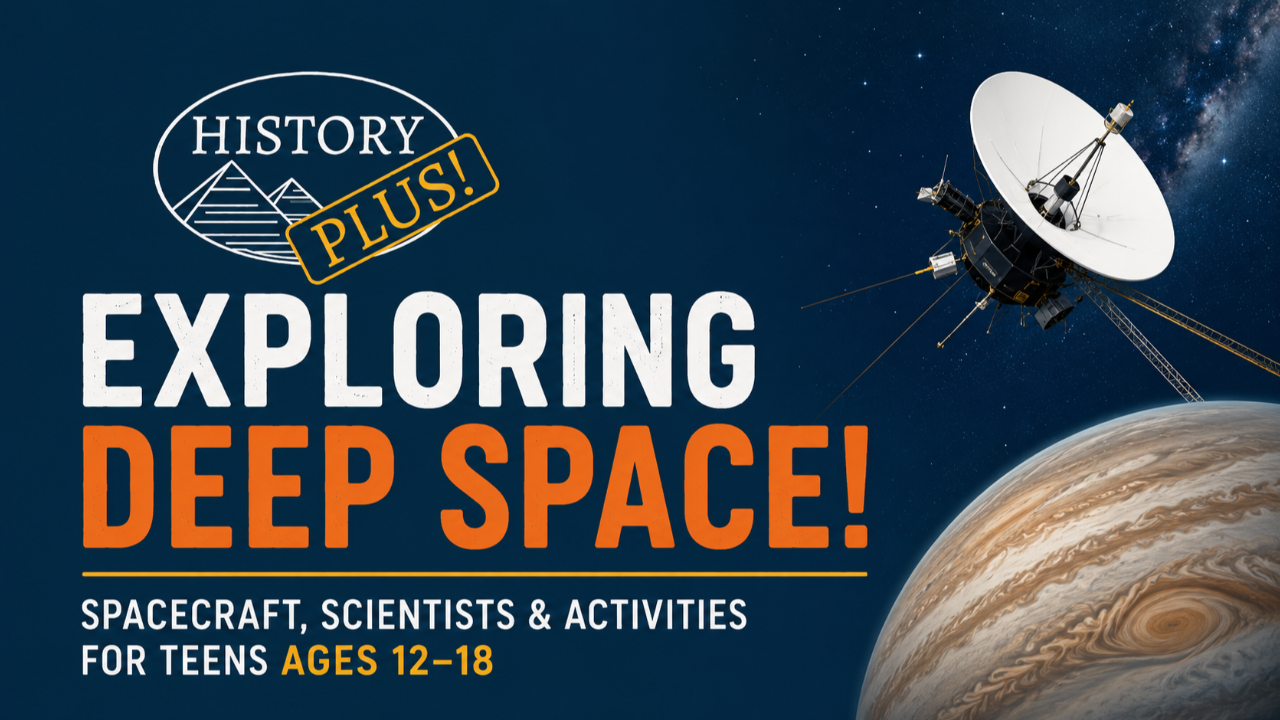
Exploring Deep Space! – Activities for Teens Ages 12–18
People studied the night sky for thousands of years before anyone could send a machine beyond Earth. By the early 20th century, scientists had begun working out the mathematics and technology needed to make spaceflight possible. A few decades later, spacecraft were travelling to the Moon, Venus, Mars, and the outer planets.
This month, we’re exploring Deep Space, including the scientists who helped make spaceflight possible, the spacecraft they built, and what those missions have taught us about our solar system and beyond.
1. The Scientists Who Made Spaceflight Possible
Modern rocketry developed through the work of scientists and engineers in several countries.
Russian scientist Konstantin Tsiolkovsky was developing mathematical theories of spaceflight by the late 1800s. He showed how rockets could operate in space and developed what became known as the rocket equation, which describes the relationship between a rocket’s mass, fuel, and changing velocity.
American scientist Robert Goddard moved from theory to experimentation. On March 16, 1926, he successfully launched a liquid-fuelled rocket in Massachusetts. The rocket rose about 12.5 m (41 ft.) before falling back to Earth.
Rocket development accelerated during the Second World War. German engineer Wernher von Braun became a leading figure in the V-2 missile program for Nazi Germany. The weapons killed thousands of people, and their production relied heavily on forced labour in brutal conditions. After the war, von Braun was brought to the United States, where he later helped develop the Saturn V rocket used during the Apollo program.
Investigate a Rocket Pioneer
Choose an early scientist or engineer involved in rocketry and find out what they contributed.
Look specifically for a problem they were trying to solve. It could involve fuel, guidance, propulsion, stability, weight, or another technical challenge.
Create a diagram showing how their work influenced a later rocket or spacecraft.
2. From Sputnik to the Planets
On October 4, 1957, the Soviet Union launched Sputnik 1, the first artificial satellite to orbit Earth.
Sputnik was a polished metal sphere about 58 cm (23 in.) across. It carried radio transmitters but no cameras or sophisticated scientific instruments. Its radio signals could be detected from Earth as it travelled overhead.
The next few years brought a rapid series of new achievements.
The Soviet Luna 2 reached the Moon in 1959, becoming the first human-made object to reach another world. NASA’s Mariner 2 flew past Venus in 1962 and returned measurements of the planet’s atmosphere and surface conditions. In 1973, Pioneer 10 became the first spacecraft to make a close encounter with Jupiter.
Build a Spacecraft Timeline
Create a timeline beginning with Sputnik 1 and add at least ten spacecraft.
For each mission, record:
- Launch date
- Destination
- Country or space agency
- Type of spacecraft
- Main objective
- One discovery or achievement
Try to include satellites, orbiters, landers, rovers, and flyby missions.
Once they’re arranged chronologically, compare the earliest spacecraft with those launched several decades later. Look at changes in their cameras, computers, communication systems, power sources, and scientific instruments.
3. Follow Voyager Through the Solar System
NASA launched Voyager 1 and Voyager 2 in 1977 to investigate the outer solar system.
Voyager 1 visited Jupiter and Saturn. Voyager 2 followed a different route that eventually took it past Jupiter, Saturn, Uranus, and Neptune. It remains the only spacecraft to have visited Uranus and Neptune.
The missions produced detailed observations of the giant planets and their moons. Voyager images helped scientists identify active volcanoes on Jupiter’s moon Io, examined the complicated structures within Saturn’s rings, and provided the first close views of Uranus and Neptune.
The spacecraft also carried the Voyager Golden Records. Each record contains photographs, diagrams, greetings, natural sounds, and music selected to provide information about Earth.
Create a Golden Record
Choose ten items that you would include on a spacecraft intended to carry information about Earth.
Your collection could include:
- Photographs
- Music
- Human languages
- Animal sounds
- Mathematics
- Maps
- Scientific diagrams
- Examples of plants and animals
Write a short explanation for each selection describing what someone could learn about Earth from it.
Then compare your choices with the material placed on the real Voyager Golden Record.
4. Meet the People Behind the Spacecraft
Large space missions involve teams of scientists, mathematicians, engineers, programmers, technicians, and mission controllers.
Katherine Johnson worked as a mathematician at NASA and calculated trajectories for several important American spaceflights. Her work contributed to John Glenn’s 1962 orbital mission and later Apollo missions.
Astronomer Carl Sagan worked with several planetary missions, including Mariner, Viking, Voyager, and Galileo. He was also involved in creating messages sent aboard the Pioneer and Voyager spacecraft.
Planetary scientist Carolyn Porco became closely associated with the Cassini mission to Saturn. She led the spacecraft’s imaging science team as Cassini studied Saturn, its rings, and its moons.
Choose one person involved in a spacecraft mission and investigate the specific work they did.
Rather than writing a general biography, concentrate on their contribution to the mission. Explain the problem they worked on, how they approached it, and what the mission was able to accomplish.
5. How Big Is a Light-Year?
Distances outside our solar system become so large that kilometres and miles aren’t particularly convenient.
Astronomers commonly use the light-year, which is a measurement of distance. One light-year is approximately 9.46 trillion km (5.88 trillion mi.).
A scale model makes that number easier to understand.
Imagine that 1 light-year = 1 km (0.62 mi.).
The nearest star to our Sun, Proxima Centauri, is about 4.24 light-years away. At our scale, you would place it 4.24 km (2.63 mi.) from the Sun.
Choose a familiar location to represent the Sun and use a map to find a landmark 4.24 km (2.63 mi.) away. That landmark represents Proxima Centauri.
At the same scale, the actual distance between Earth and the Sun would shrink to only about 1.6 cm (0.63 in.).
You can model that part with two small objects on a table. Place one object at the Sun and Earth 1.6 cm (0.63 in.) away. Then compare that tiny separation with the 4.24 km (2.63 mi.) you mapped to the next star.
6. Create a Spacecraft Museum
Spacecraft designs have changed considerably since Sputnik.
Some spacecraft are built to orbit planets for years. Others land, deploy rovers, collect samples, pass close to their targets, or observe the universe without ever leaving the region around Earth.
Choose six spacecraft from different periods and create a small Spacecraft Museum.
Good choices include:
- Sputnik 1
- Luna 2
- Mariner 2
- Voyager 1 or 2
- Galileo
- Cassini
- Hubble Space Telescope
- New Horizons
- Curiosity or Perseverance
- James Webb Space Telescope
Create a museum card for each spacecraft with its launch date, destination, purpose, major instruments, and an important discovery or achievement.
Add a drawing or photograph of each spacecraft and compare their designs. Look at antennas, solar panels, cameras, wheels, protective shielding, and other equipment. Try to determine why each spacecraft looks the way it does.
Keep Exploring
Spacecraft have explored every planet in our solar system, landed on moons and asteroids, travelled through the atmospheres of other worlds, and carried scientific instruments far beyond the orbit of Neptune.
Those missions grew out of more than a century of work in mathematics, astronomy, physics, engineering, and computer science. Studying the spacecraft alongside the people who designed and operated them gives us a much better picture of how space exploration developed.
Hands-On Activities & Projects
- NASA JPL – Touchdown! — Design a spacecraft landing system that protects its payload during impact, then test and improve the design.
- Science Buddies – Rocket Science Projects — Explore hands-on projects involving rockets, aerodynamics, flight, propulsion, and spacecraft-related engineering.
- TeachEngineering – Rockets — A collection of lessons and experiments exploring rocket design, propulsion, Newton’s laws, and the engineering involved in reaching space.
Websites & Further Exploration
- NASA – Voyager Mission — Follow Voyager 1 and Voyager 2 and explore their journeys through the outer solar system, major discoveries, instruments, and continuing missions.
- NASA – Katherine Johnson Biography — Learn about Katherine Johnson’s work as a NASA mathematician and her contributions to some of the most important early American space missions.
- Smithsonian National Air and Space Museum – Spaceflight — Explore spacecraft, astronauts, rockets, satellites, and artifacts from the history of human and robotic space exploration.
- The Planetary Society – Space Missions — An excellent collection of current and historic missions to planets, moons, asteroids, comets, and other destinations.
- European Space Agency – Space Science — Explore European missions investigating planets, comets, the Sun, stars, and deep space.
- National Geographic – Space Exploration — Articles, photographs, and features covering astronomy, spacecraft, discoveries, and the history of exploring space.
Books
- Beyond: The Astonishing Story of the First Human to Leave Our Planet and Journey into Space — Stephen Walker — A detailed account of Yuri Gagarin, the early Space Race, and the people and technology behind the first human journey into space. Best for older teens.
- Hidden Figures: Young Readers’ Edition — Margot Lee Shetterly — The story of the Black women mathematicians at NASA whose calculations contributed to America’s early space program, including Katherine Johnson.
- The Right Stuff — Tom Wolfe — A classic account of America’s experimental test pilots, the Mercury astronauts, and the dangerous early years of the American space program. Best for mature teens.
- Chasing New Horizons — Alan Stern & David Grinspoon — The story of the New Horizons mission and the decades of work required to send a spacecraft to Pluto. An excellent look at how a modern planetary mission actually comes together.
- Spaceflight: The Complete Story from Sputnik to Curiosity — Giles Sparrow — A heavily illustrated history of spacecraft and space exploration covering satellites, planetary probes, human missions, and Mars exploration.
Amazon.ca – Spaceflight by Giles Sparrow - Rocket Men — Robert Kurson — The story of Apollo 8 and the astronauts who became the first humans to travel to the Moon and orbit it. Best suited to older teens and adults.
Join History Plus and experience history in a whole new way.
History Plus members can join us throughout November as we explore Deep Space, the scientists who helped us understand it, and the spacecraft used to investigate our solar system and beyond.